


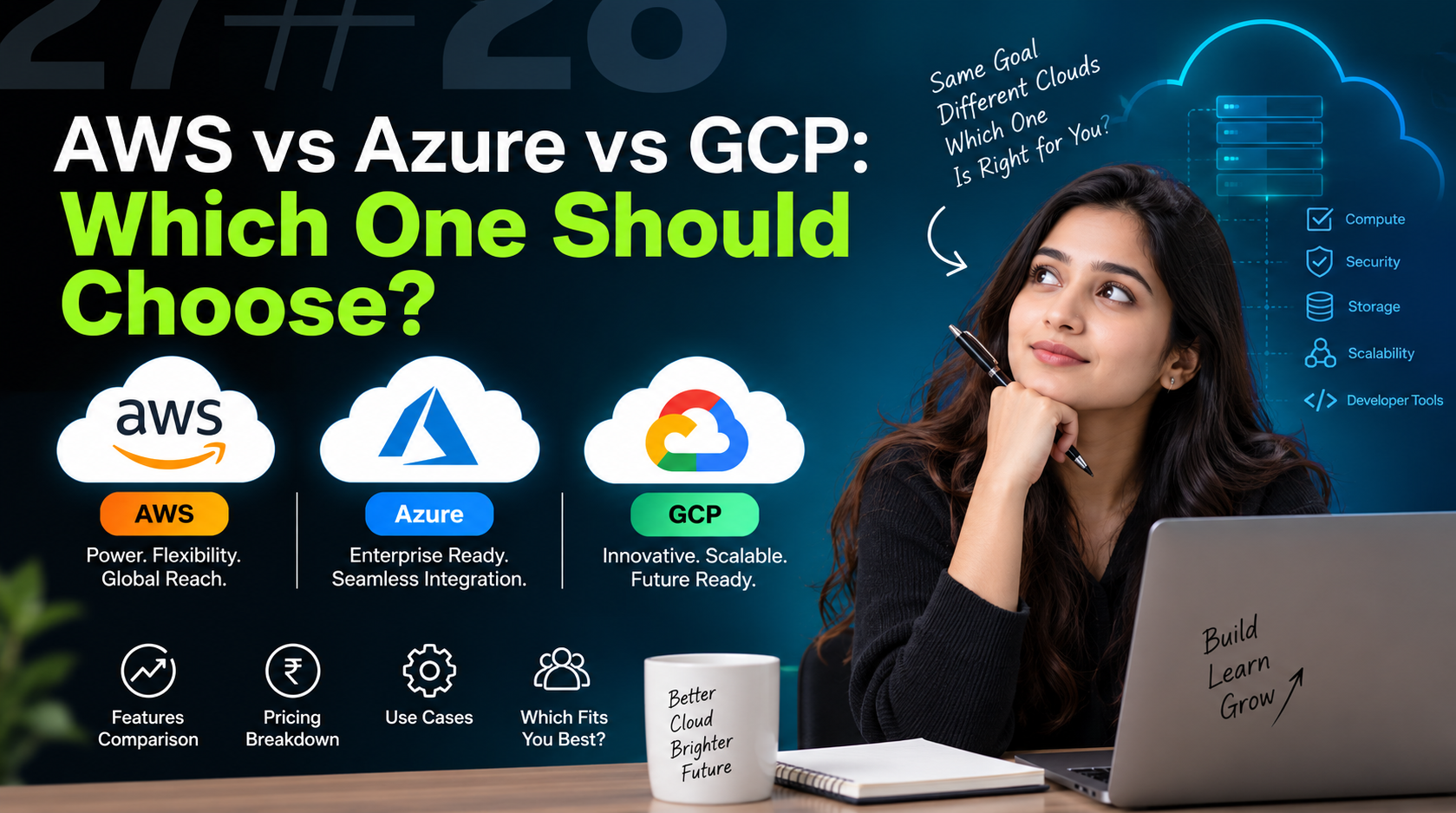
If you are wondering AWS vs Azure vs GCP: Which One Should Choose?, you are not alone. Amazon Web Services (AWS), Microsoft Azure, and Google Cloud Platform (GCP) are three of the most widely used cloud computing platforms in the world. Each platform offers powerful infrastructure, storage, databases, artificial intelligence, security, and application development services, but their pricing, features, ecosystems, and ideal use cases can differ. This guide compares AWS, Azure, and GCP to help businesses, developers, startups, and professionals choose the right cloud platform for their needs.
What Are AWS, Azure, and GCP?
AWS, Azure, and GCP are cloud computing platforms that allow businesses and developers to access computing resources over the internet instead of maintaining all infrastructure on-premises.
What Is Amazon Web Services (AWS)?
Amazon Web Services is the cloud platform operated by Amazon. AWS provides a large portfolio of services covering computing, storage, databases, networking, security, analytics, machine learning, and application development.
AWS is widely used by startups, enterprises, developers, and organizations that need a broad selection of cloud services.
What Is Microsoft Azure?
Microsoft Azure is Microsoft’s cloud computing platform. It provides services for application development, virtual machines, databases, networking, analytics, artificial intelligence, security, and hybrid cloud environments.
Azure can be particularly attractive to organizations already using Microsoft technologies and enterprise software.
What Is Google Cloud Platform (GCP)?
Google Cloud Platform, commonly called GCP, is Google’s cloud platform. It offers computing, storage, databases, networking, analytics, artificial intelligence, and machine learning services.
GCP is known for its data analytics, machine learning, Kubernetes, and container-related technologies.
AWS vs Azure vs GCP: Key Differences
When comparing AWS vs Azure vs GCP, there is no universal winner. The best platform depends on your business requirements, existing technology stack, budget, technical expertise, and future growth plans.
AWS vs Azure vs GCP for Infrastructure
AWS provides a broad range of infrastructure services and has a mature cloud ecosystem.
Azure offers strong infrastructure capabilities and integrates closely with Microsoft’s enterprise environment.
GCP provides strong infrastructure capabilities with particular strengths in data, analytics, containers, and machine learning.
AWS vs Azure vs GCP for Artificial Intelligence
All three cloud providers offer artificial intelligence and machine learning services.
AWS provides a broad range of AI and machine learning services through its cloud ecosystem.
Azure integrates AI capabilities with Microsoft’s broader business and developer ecosystem.
GCP benefits from Google’s experience in artificial intelligence, machine learning, data processing, and analytics.
For organizations heavily focused on AI and data workloads, GCP can be an attractive option, while AWS and Azure also provide extensive AI capabilities.
AWS vs Azure vs GCP Pricing
Cloud pricing can vary significantly depending on the services, region, usage, storage, computing requirements, and discounts involved.
How AWS Pricing Works
AWS generally uses usage-based pricing across many services. Businesses can also use different purchasing and discount models depending on their workload.
How Azure Pricing Works
Azure also offers consumption-based pricing along with various options for organizations with predictable workloads and existing Microsoft licensing arrangements.
How GCP Pricing Works
GCP provides usage-based pricing across its services and offers different pricing mechanisms depending on the service and workload.
Which Cloud Platform Is Cheapest?
There is no single answer to which platform is cheapest. A service that costs less on one platform may cost more on another depending on configuration and usage.
Instead of comparing headline prices, businesses should calculate their expected total cost of ownership, including computing, storage, networking, databases, support, licenses, and data transfer.
AWS vs Azure vs GCP for Businesses
Choosing a cloud provider should start with your business requirements rather than popularity.
AWS for Businesses
AWS can be a strong choice for businesses that need a broad range of cloud services and flexibility across different workloads.
It can be suitable for:
- Startups
- SaaS companies
- E-commerce businesses
- Enterprise applications
- Large-scale infrastructure
- Organizations with diverse cloud requirements
Azure for Businesses
Azure can be a strong choice for organizations already using Microsoft’s ecosystem.
It can be suitable for:
- Enterprises
- Microsoft-based organizations
- Hybrid cloud environments
- Organizations using Microsoft 365
- Windows-based applications
- Businesses requiring enterprise integration
GCP for Businesses
GCP can be a strong choice for organizations focused on data, analytics, artificial intelligence, machine learning, and modern cloud-native applications.
It can be suitable for:
- Data-driven companies
- AI-focused businesses
- Technology startups
- Analytics workloads
- Containerized applications
- Cloud-native development
AWS vs Azure vs GCP for Startups
Startups usually need flexibility, scalability, and predictable costs.
Which Cloud Platform Is Best for Startups?
AWS, Azure, and GCP can all work well for startups. The right choice depends on the startup’s technical requirements and existing ecosystem.
A startup building a highly scalable SaaS product may consider AWS. A startup already relying heavily on Microsoft technologies may prefer Azure, while a company focused on analytics or AI may consider GCP.
Startups should also evaluate free tiers, startup programs, documentation, developer tools, support, and the availability of engineers with relevant cloud skills.
AWS vs Azure vs GCP for Developers
Developers should consider more than just the number of available services.
Developer Experience
AWS offers a large ecosystem and extensive documentation.
Azure provides strong integration with Microsoft’s developer tools and enterprise technologies.
GCP offers a developer-friendly environment for cloud-native applications, containers, Kubernetes, data engineering, and machine learning.
The best option often depends on the programming languages, frameworks, databases, deployment tools, and development workflows your team already uses.
AWS vs Azure vs GCP for Cloud Security
Security is a critical consideration when selecting a cloud provider.
AWS Security
AWS provides tools for identity management, encryption, monitoring, network security, compliance, and infrastructure protection.
Azure Security
Azure provides security services across identity, applications, networks, data, and cloud infrastructure, with strong integration into Microsoft’s security ecosystem.
GCP Security
GCP provides security controls for infrastructure, identity, applications, data, and network environments.
Businesses should remember that cloud security is a shared responsibility. Choosing a major cloud provider does not automatically make an application secure; organizations must configure and manage their environments correctly.
AWS vs Azure vs GCP: Which One Should Choose for Your Business?
The answer depends on what you need from your cloud platform.
Choose AWS If You Need a Broad Cloud Ecosystem
AWS can be a good option if you want extensive cloud services, flexibility, and a mature ecosystem.
Choose Azure If Your Business Uses Microsoft Technologies
Azure can make sense if your organization already depends heavily on Microsoft products, services, and enterprise infrastructure.
Choose GCP If Data and AI Are Your Priority
GCP can be worth considering if your workloads are heavily focused on analytics, artificial intelligence, machine learning, containers, or cloud-native development.
How to Choose the Right Cloud Platform
Before making a decision, evaluate your requirements carefully.
Consider Your Current Technology
Look at your existing operating systems, databases, applications, identity systems, developer tools, and business software.
Calculate Your Cloud Costs
Estimate your expected computing, storage, networking, database, support, and data-transfer costs rather than relying only on advertised prices.
Evaluate Scalability
Consider how easily the platform can support your expected growth in users, applications, traffic, and data.
Check Available Skills
Your team’s existing cloud knowledge can significantly affect migration time, operational costs, and project success.
Consider Security and Compliance
Review the security controls and compliance requirements relevant to your industry and geographical markets.
Cloud Migration and SEO: Why Your Cloud Infrastructure Matters
Moving a website or application to the cloud can improve scalability, reliability, and operational flexibility when the infrastructure is designed correctly. However, cloud migration should not be treated as an SEO strategy by itself.
After moving your website, you should monitor performance, redirects, indexing, uptime, crawlability, and technical SEO.
For businesses working on their overall search visibility, building authoritative and relevant links is another important part of SEO. You can learn more in our guide on How to Build Backlinks (White Hat) – Complete SEO Guide, which explains ethical approaches to building backlinks and strengthening your website’s authority.
Common Mistakes When Choosing a Cloud Provider
Choosing Based Only on Price
The cheapest individual service does not necessarily result in the lowest overall cloud cost.
Choosing Based Only on Popularity
The most popular provider may not be the best fit for your particular workload.
Ignoring Data Transfer Costs
Network and data-transfer charges can become significant for certain applications.
Overlooking Migration Complexity
Moving applications between cloud environments can require significant planning, testing, and technical resources.
Not Planning for Long-Term Growth
Your cloud provider should support your business not only today but also as your applications, customers, and data grow.
AWS vs Azure vs GCP: Comparison Summary
AWS, Azure, and GCP are all powerful cloud platforms, but they have different strengths.
AWS
Best suited for businesses looking for a broad and mature cloud ecosystem with extensive service choices.
Azure
Best suited for organizations that rely heavily on Microsoft technologies and enterprise environments.
GCP
Best suited for businesses with strong requirements around data analytics, AI, machine learning, containers, and cloud-native workloads.
Final Thoughts on AWS vs Azure vs GCP: Which One Should Choose?
There is no single winner in the AWS vs Azure vs GCP: Which One Should Choose? debate. AWS, Azure, and GCP can all provide scalable, secure, and powerful cloud infrastructure. Your decision should be based on your workload, budget, existing technology, team expertise, security requirements, and long-term business goals.
For a startup, AWS may provide the flexibility and service variety it needs. For a Microsoft-focused enterprise, Azure may offer stronger ecosystem integration. For an AI- or data-focused organization, GCP may be an attractive choice. The smartest approach is to compare your actual requirements and estimated costs before committing to a platform.
What Are High DA PA Websites For Backlinking?
High DA PA websites are authoritative platforms that allow you to create backlinks pointing to your website.
 Why High DA PA Backlinks Matter
- Improve search engine rankings

- Increase website authority
- Drive high-quality referral traffic
- Build trust with Google
- Help faster indexing
1000+ High DA PA Websites For Backlinking – Categories
Instead of random links, use categorized platforms for better results
1. High DA Social Bookmarking Sites
- Mix
- Scoop.it
- Slashdot
- Folkd
 Great for quick indexing and traffic
2. High DA Profile Creation Sites
- About.me
- Behance
- Dribbble
- GitHub
- Medium
Helps build brand authority
3. Guest Posting Websites
- Blogging platforms in your niche
- Industry-specific blogs
- Business websites
Best for high-quality contextual backlinks
4. Article Submission Sites
- Medium
- EzineArticles
- HubPages
- LinkedIn Articles
Useful for content-based backlinks
5. Forum Submission Sites
- Quora
- Warrior Forum
Engage and add value before linking
6. Business Listing & Directory Sites
- Google Business Profile
- Yelp
- Justdial
- IndiaMART
- Important for local SEO
How to Use High DA PA Websites For Backlinking Effectively
Step-by-Step Strategy
- Choose relevant websites in your niche
- Create high-quality profiles/content
- Add your website link naturally
- Avoid spammy or over-optimized links
- Maintain consistency
 Common Mistakes to Avoid
Avoid These Errors
- Using low-quality or spam websites

- Creating too many backlinks quickly
- Ignoring content quality
- Using the same anchor text repeatedly
- Not diversifying backlink sources
 Pro Tips to Get Better Results
Advanced Strategies
- Combine backlinks with content marketing
- Focus on niche-relevant websites
- Build backlinks gradually
- Track backlinks using SEO tools
- Prioritize quality over quantity
 How High DA PA Backlinks Improve SEO
High authority backlinks help search engines understand that your website is trustworthy and valuable.
SEO Benefits
- Higher keyword rankings
- Increased organic traffic
- Strong domain authority
- Better visibility on search engines
 Final Thoughts on 1000+ High DA PA Websites For Backlinking
Using 1000+ high DA PA websites for backlinking can accelerate your SEO growth when done correctly. Focus on building quality backlinks from trusted platforms, avoid spam techniques, and stay consistent. A smart backlink strategy will help you rank higher, drive traffic, and grow your online presence globally.
